
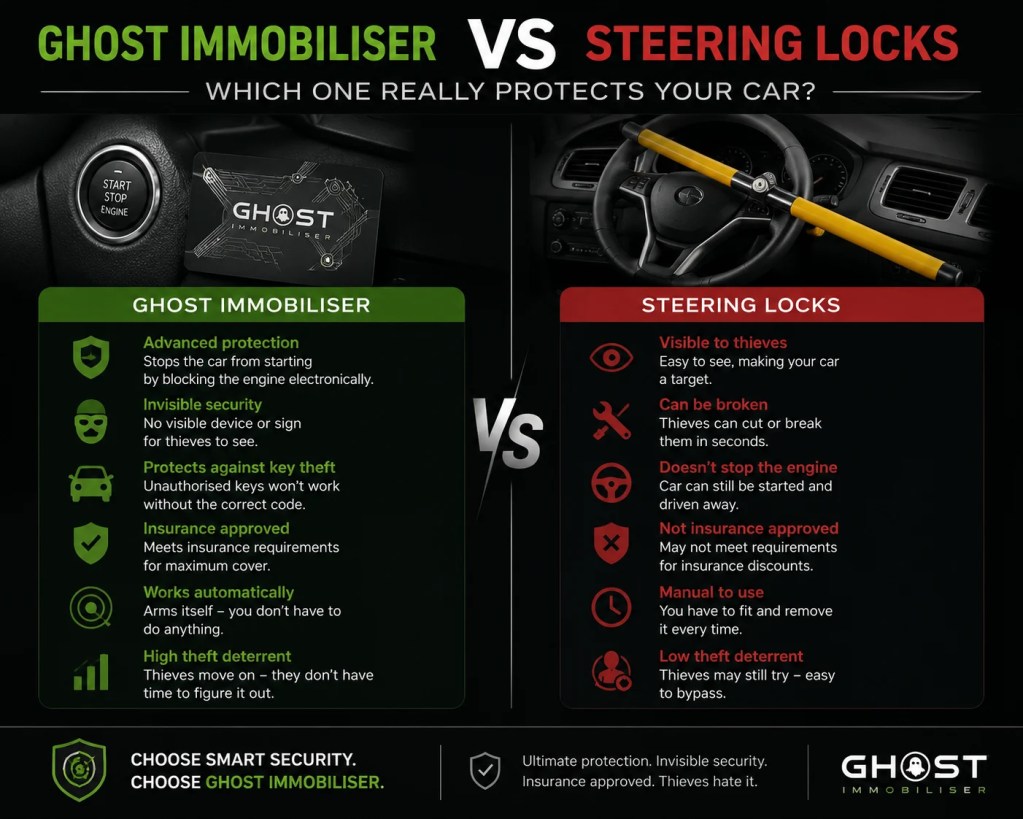
Ghost Immobiliser vs Steering Locks: Which Is Best for Car Security?
Car theft is becoming increasingly sophisticated, and relying only on your vehicle’s standard security may not always provide the level of protection you want. From keyless-entry attacks to stolen keys and electronic theft techniques, modern vehicles can face several different security risks.
This is why many car owners compare Ghost Immobiliser vs Steering Locks when looking for an additional layer of protection.
Both security solutions have advantages, but they work in completely different ways. A Ghost Immobiliser provides discreet electronic protection, while a steering lock creates a visible physical barrier. Understanding these differences can help you choose the right security solution for your vehicle.
In this guide, we’ll explore Ghost Immobiliser vs Steering Locks, how each system works, their advantages and limitations, and whether using both could provide stronger vehicle security.
What Is a Ghost Immobiliser?
A Ghost Immobiliser is an aftermarket electronic vehicle security system designed to prevent unauthorised starting.
Unlike a conventional steering lock, it does not physically block the steering wheel. Instead, it works with the vehicle’s electronic systems and can require a personalised PIN sequence before the vehicle can be driven.
The system is designed to remain discreet, meaning there is no need for a large visible security device attached to the steering wheel.
For drivers researching Ghost Immobiliser vs Steering Locks, this discreet approach is one of the biggest differences between the two.
A properly installed electronic immobiliser can provide an additional layer of protection alongside the vehicle’s existing factory security.
What Is a Steering Lock?
A steering lock is a mechanical anti-theft device designed to prevent or restrict the steering wheel from being turned.
It is normally fitted directly to the steering wheel and must be removed before the vehicle can be driven normally.
One of the main advantages of this type of security is its visibility. A potential thief can see the steering lock through the vehicle’s windows, immediately indicating that an additional security measure is being used.
This makes a steering lock particularly useful as a visual deterrent.
However, unlike an electronic immobiliser, it does not normally prevent the vehicle from being started. Its primary function is to create a physical obstacle to driving the vehicle.
Ghost Immobiliser vs Steering Locks: What Is the Difference?
The biggest difference in the Ghost Immobiliser vs Steering Locks comparison is the type of protection they provide.
A Ghost Immobiliser is an electronic security solution, whereas a steering lock is a mechanical security solution.
A Ghost Immobiliser can require driver authentication before the vehicle starts. A steering lock physically restricts the steering wheel and creates a visible deterrent.
Here’s a simple comparison:
| Feature | Ghost Immobiliser | Steering Lock |
|---|---|---|
| Security type | Electronic | Mechanical |
| Visible to thieves | Generally discreet | Highly visible |
| Requires installation | Yes | No professional installation normally required |
| Physical steering restriction | No | Yes |
| Adds starting authentication | Yes | No |
| Daily removal required | No | Yes |
| Works independently of vehicle electronics | No | Yes |
| Provides a visual deterrent | Limited | Strong |
| Can complement factory security | Yes | Yes |
The best choice depends on what you want your additional security system to achieve.
How Does a Ghost Immobiliser Protect Your Car?
A Ghost Immobiliser is designed to add an additional authentication stage to the vehicle-starting process.
Once installed and configured, the driver uses a personalised sequence through selected vehicle controls. Without the correct authentication, the vehicle can be prevented from starting normally.
This creates an additional barrier if someone gains access to the vehicle.
One important advantage when comparing Ghost Immobiliser vs Steering Locks is that the electronic system can be discreet. A thief may not immediately know that an additional immobilisation system has been fitted.
However, vehicle security systems should never be considered completely theft-proof. The purpose of additional security is to make unauthorised use more difficult and increase the number of barriers a thief must overcome.
How Does a Steering Lock Protect Your Car?
A steering lock takes a much more straightforward approach.
Once attached, the device physically restricts movement of the steering wheel. Even if someone gains entry to the vehicle, they must deal with the physical security device before they can steer the car normally.
The highly visible design can also discourage some thieves from attempting to target the vehicle.
This is where the Ghost Immobiliser vs Steering Locks comparison becomes particularly interesting: one system is designed to remain discreet, while the other deliberately makes its presence obvious.
Benefits of a Ghost Immobiliser
There are several reasons vehicle owners consider an electronic immobiliser.
Discreet Security
A Ghost Immobiliser does not need to be visibly attached to the steering wheel. Its discreet nature means there may be no obvious aftermarket security device for someone outside the vehicle to identify.
Additional Starting Protection
The system can require a personalised PIN before authorised driving, adding another security layer beyond the vehicle’s factory systems.
Convenient for Daily Driving
Unlike a traditional steering lock, there is no physical device that needs to be attached and removed every time you park and drive.
Suitable for High-Risk Vehicles
Owners of luxury, performance and frequently targeted vehicles may want additional protection beyond the factory-installed security features.
Benefits of a Steering Lock
Steering locks continue to be popular because they provide several straightforward benefits.
Strong Visual Deterrent
The device can be seen from outside the vehicle. This makes its presence immediately obvious to anyone considering targeting the car.
Physical Barrier
A steering lock creates a mechanical obstacle that must be overcome before the steering wheel can be used normally.
Simple Technology
There is no vehicle software, electronic integration or PIN sequence involved with a conventional mechanical steering lock.
Independent Security Layer
Because it is mechanical, it provides protection separately from the vehicle’s electronic security systems.
Ghost Immobiliser vs Steering Locks: Which Is More Effective?
So, which option wins the Ghost Immobiliser vs Steering Locks debate?
There isn’t one answer that applies to every vehicle.
If your priority is a visible physical deterrent, a steering lock can be an effective additional security measure.
If you want discreet electronic protection against unauthorised starting, a Ghost Immobiliser offers a different approach.
The two products should not necessarily be considered direct replacements for each other. They address different parts of the vehicle theft problem.
For this reason, some owners may choose to use both.
Should You Use a Ghost Immobiliser and Steering Lock Together?
Using multiple layers of vehicle security can make sense for owners who want additional protection.
A steering lock can provide the visible deterrent, while a Ghost Immobiliser can add an electronic authentication layer.
This means a thief potentially faces two different security barriers rather than one.
A layered setup could include:
- A Ghost Immobiliser for electronic starting protection
- A steering lock for physical deterrence
- A suitable tracker for vehicle recovery
- Secure key storage for keyless vehicles
- Secure parking wherever possible
When considering Ghost Immobiliser vs Steering Locks, remember that combining security measures can sometimes provide more comprehensive protection than choosing only one.
Which Is Better for Keyless Cars?
Keyless vehicles require particular attention because thieves can use different techniques to gain access or attempt to start a vehicle.
A steering lock can provide a physical obstacle once someone enters the vehicle, but it does not interact with the vehicle’s keyless system.
An electronic immobiliser provides a different layer by adding authentication to the starting process.
Keyless-car owners should also consider basic precautions such as storing keys away from doors and windows and following the vehicle manufacturer’s security recommendations.
Ghost Immobiliser vs Steering Locks for High-Value Cars
Owners of high-value vehicles often have more reason to consider additional security.
Luxury SUVs, performance cars and premium vehicles can attract unwanted attention, making a layered approach worth considering.
A steering lock provides a visible warning that additional protection is present. An electronic immobiliser provides a discreet layer that may not be obvious to someone attempting to steal the vehicle.
For high-value cars, combining preventative security with a suitable tracking system can also provide additional protection and recovery capability.
Can a Ghost Immobiliser Replace a Steering Lock?
A Ghost Immobiliser should not automatically be considered a replacement for a steering lock.
The two devices serve different purposes.
A Ghost Immobiliser focuses on electronic starting security, while a steering lock focuses on physically restricting steering and providing a visible deterrent.
Therefore, the answer depends on your security priorities.
If you want a highly visible mechanical deterrent, a steering lock may be useful. If you want discreet electronic protection, an immobiliser may be more appropriate.
If you want both types of protection, there is no need to choose between them.
Final Verdict: Ghost Immobiliser vs Steering Locks
The Ghost Immobiliser vs Steering Locks comparison ultimately comes down to the type of protection you want.
A steering lock provides a visible physical barrier that can deter thieves and make steering the vehicle more difficult. A Ghost Immobiliser provides a discreet electronic security layer that can require authorised authentication before the vehicle can be started.
Neither solution should be viewed as a complete replacement for every other security measure.
For everyday drivers, one additional security layer may be enough. For owners of high-value or higher-risk vehicles, combining a Ghost Immobiliser with a steering lock and suitable tracking technology can create a stronger, layered security strategy.
The most important thing is to choose security measures that match your vehicle, your circumstances and the risks you are trying to reduce.
Frequently Asked Questions
Is a Ghost Immobiliser better than a steering lock?
A Ghost Immobiliser and steering lock provide different forms of protection. A Ghost Immobiliser focuses on electronic starting authentication, while a steering lock provides a physical restriction and visible deterrent. The better option depends on your security requirements.
Can a steering lock stop a car from being stolen?
A steering lock can make a vehicle harder to drive by restricting steering and can discourage some thieves because it is clearly visible. However, it does not provide the same electronic starting protection as an immobiliser.
Does a Ghost Immobiliser prevent car theft?
A Ghost Immobiliser is designed to prevent unauthorised starting by requiring the correct authentication. However, no vehicle security product can guarantee that a car will never be stolen. Using multiple security measures can provide additional protection.
Can you use a Ghost Immobiliser with a steering lock?
Yes. They can complement each other because they provide different security layers. The steering lock offers physical and visible protection, while the Ghost Immobiliser provides discreet electronic protection.
Is a steering lock still useful in 2026?
Yes. Although vehicle theft methods have become more technologically advanced, a visible mechanical deterrent can still form part of a layered security strategy.
Should I get an immobiliser or a tracker?
An immobiliser and tracker have different purposes. An immobiliser is intended to help prevent unauthorised use, while a tracker can assist with locating a vehicle if it is stolen. Higher-risk vehicles may benefit from using both.
Is a Ghost Immobiliser suitable for a keyless vehicle?
A Ghost Immobiliser can provide an additional security layer for many keyless vehicles. However, owners should also follow recommended keyless-security practices and consider other suitable security measures.
What is the biggest difference between a Ghost Immobiliser and a steering lock?
The biggest difference is how they protect the vehicle. A Ghost Immobiliser provides discreet electronic starting protection, while a steering lock creates a visible physical barrier. Because they work differently, they can complement rather than replace each other.
Follow us on instagram.