
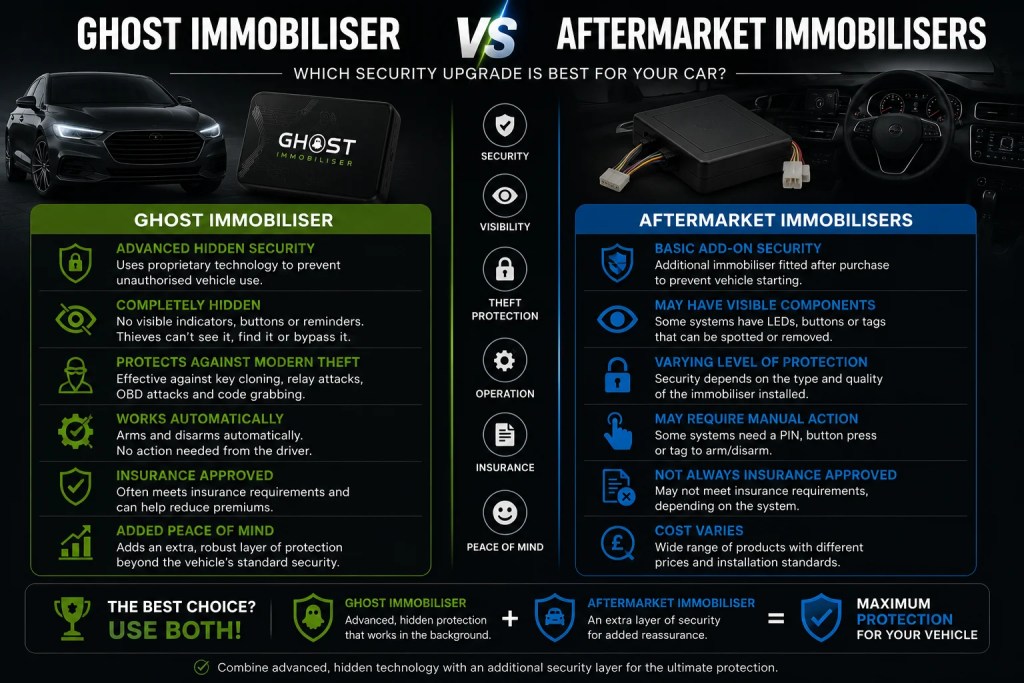
Ghost Immobiliser vs Aftermarket Immobilisers: 7 Powerful Differences
Vehicle theft has become a growing concern for car owners, particularly those with high-value, luxury and frequently targeted vehicles. Although modern cars already come with factory security systems, some drivers choose to add aftermarket protection for an additional layer of security.
One popular option is a Ghost Immobiliser. However, it is not the only aftermarket immobiliser available.
When comparing Ghost Immobiliser vs Aftermarket Immobilisers, it is important to understand that “aftermarket immobiliser” is a broad category. Different products can use different technologies, authentication methods and installation approaches.
So, what makes a Ghost Immobiliser different from other aftermarket immobilisers?
In this guide, we’ll look at seven important differences, compare their features and explain what you should consider before choosing an additional vehicle security system.
What Is an Aftermarket Immobiliser?
An aftermarket immobiliser is an electronic security system installed in a vehicle after it leaves the factory.
Its purpose is generally to prevent unauthorised starting or use of the vehicle. Depending on the product, it may interrupt or control one or more vehicle functions required for starting.
Aftermarket immobilisers can vary considerably. Some may use a remote control, key fob, PIN code, smartphone authentication or another form of driver identification.
This means you should not assume that every aftermarket immobiliser offers the same level or type of protection.
What Is a Ghost Immobiliser?
A Ghost Immobiliser is an aftermarket electronic vehicle security system designed to add an additional authentication layer to compatible vehicles.
Instead of requiring a separate visible control device, a Ghost Immobiliser can use a personalised PIN sequence entered through existing vehicle controls.
The system is designed to be discreet and can work alongside the vehicle’s original factory security.
This is an important point in the Ghost Immobiliser vs Aftermarket Immobilisers comparison: a Ghost Immobiliser is itself an aftermarket immobiliser, but its specific design and authentication approach distinguish it from other products in the wider category.
Ghost Immobiliser vs Aftermarket Immobilisers: 7 Key Differences
1. Authentication Method
One of the biggest differences between aftermarket immobilisers is how they authenticate the authorised driver.
A Ghost Immobiliser can use a personalised PIN sequence entered through existing vehicle controls.
Other aftermarket systems may use different authentication methods, such as remote controls, key fobs, smartphone applications or other technologies.
The authentication method can affect convenience, discretion and how the system fits into your daily driving routine.
When comparing Ghost Immobiliser vs Aftermarket Immobilisers, always check exactly how the product confirms authorised use.
2. Discreet Design
A major attraction of a Ghost Immobiliser is its discreet approach.
There is no requirement for a prominent aftermarket control panel or large physical device to be attached to the steering wheel.
This can make the security system less obvious to someone looking inside the vehicle.
Other aftermarket immobilisers may have visible indicators, buttons or control units depending on the product.
For owners who prioritise discreet security, the installation design should therefore be an important consideration.
3. Vehicle Integration
Different aftermarket immobilisers can integrate with a vehicle’s electronic architecture in different ways.
A Ghost Immobiliser is designed to integrate with compatible vehicle electronics and provide an additional layer of security.
Other aftermarket systems may use different installation methods depending on their design and the vehicle being protected.
Because modern vehicles contain complex electronic networks, professional installation and vehicle compatibility are extremely important.
4. PIN-Based Driver Authentication
Another important factor in the Ghost Immobiliser vs Aftermarket Immobilisers comparison is PIN-based authentication.
A personalised PIN can allow the authorised driver to identify themselves using existing controls within the vehicle.
This eliminates the need to carry another physical security key specifically for the immobiliser.
The exact operation and available features depend on the specific Ghost system and vehicle.
If you’re comparing products, check how easy it is to configure the authentication method and what happens if the driver forgets the PIN.
5. Visible Deterrence
Not all security systems are designed to be invisible.
Some aftermarket immobilisers may use visible LED indicators or other signs showing that an additional security system has been installed.
A Ghost Immobiliser is designed to be discreet rather than acting primarily as a visual deterrent.
This creates an interesting difference between visible and concealed vehicle security.
A visible security product can potentially discourage opportunistic theft, while discreet security can make it harder for a thief to immediately identify the exact system fitted to the vehicle.
6. Convenience for Daily Driving
Daily usability should not be overlooked when choosing an immobiliser.
A steering lock, for example, needs to be physically attached and removed whenever you use the vehicle.
An electronic immobiliser is integrated into the vehicle, so there is no separate physical device to store.
With a Ghost Immobiliser, the driver can use the configured PIN sequence to authenticate before driving.
Other aftermarket immobilisers may use different procedures.
The best choice depends on whether you prioritise PIN authentication, automatic operation, smartphone access or another method.
7. Security Features and Compatibility
Not every aftermarket immobiliser is suitable for every vehicle.
Compatibility is one of the most important factors to investigate before installation.
A reputable installer should check the make, model, year and electronic architecture of your vehicle before recommending a particular system.
You should also consider whether the product has recognised security certification where relevant.
Thatcham Research operates security certification schemes for vehicle security products, and its certification framework covers different categories of vehicle security and tracking technology.
Certification, however, should not be confused with an automatic guarantee that every insurer will provide a discount. Insurance requirements and recognition can vary between providers.
Ghost Immobiliser vs Aftermarket Immobilisers: Comparison Table
| Feature | Ghost Immobiliser | Other Aftermarket Immobilisers |
|---|---|---|
| Type | Electronic immobiliser | Electronic immobiliser |
| PIN authentication | Available | Depends on product |
| Discreet design | Yes | Depends on product |
| Vehicle integration | Designed for compatible vehicles | Varies |
| Separate remote required | Generally no dedicated immobiliser remote | Depends on product |
| Installation required | Yes | Yes |
| Works with factory security | Designed as an additional layer | Depends on system |
| Compatibility | Vehicle-specific | Vehicle-specific |
| Security certification | Depends on specific product/version | Depends on product |
| Features | Varies by system | Varies widely |
Is a Ghost Immobiliser Better Than Other Aftermarket Immobilisers?
There is no single immobiliser that is automatically the best choice for every vehicle.
The Ghost Immobiliser vs Aftermarket Immobilisers decision should be based on the specific features you need.
A Ghost Immobiliser may appeal to drivers who want discreet security and PIN-based authentication.
Another aftermarket immobiliser might be more appropriate if you prefer a different authentication method or require a particular feature.
The most important thing is to compare the actual specifications rather than choosing based solely on the product name.
Ghost Immobiliser vs Aftermarket Immobilisers for Keyless Cars
Keyless vehicles can face additional security considerations because of the technology used for passive entry and starting.
Adding Ghost Immobiliser vs Aftermarket Immobilisers can provide another security layer, but it should not be considered a complete solution to every keyless theft method.
Keyless-car owners should also consider practical precautions such as keeping keys away from external doors and windows and using suitable signal-blocking storage where appropriate.
A layered approach can include:
- Factory vehicle security
- Electronic immobilisation
- Suitable tracking technology
- Physical security devices
- Secure key storage
- Secure parking
Different security measures address different risks.
What Should You Check Before Buying an Aftermarket Immobiliser?
Before choosing an electronic immobiliser, consider the following:
Vehicle Compatibility
Make sure the system is specifically compatible with your vehicle.
Installer Experience
Choose an installer with experience working with your vehicle’s electronic systems.
Security Certification
Check whether the specific product has relevant security certification and whether it meets your insurer’s requirements.
Authentication Method
Understand exactly how you will disarm or authenticate the system every time you drive.
Warranty and Support
Ask about installation warranty, product support and what happens if the system develops a fault.
Insurance Requirements
If you’re purchasing additional security because of your insurance policy, confirm the exact requirements with your insurer before installation.
Should You Combine an Immobiliser With a Tracker?
An immobiliser and tracker serve different purposes.
An immobiliser is primarily designed to help prevent unauthorised use, while a tracker can assist with locating a vehicle after theft.
For higher-value vehicles, combining preventative security with recovery technology can therefore create a more comprehensive security strategy.
You could also consider a visible mechanical deterrent, such as a steering lock, depending on your circumstances.
The goal is not to install as many products as possible. Instead, it is to create sensible layers that address different risks.
How to Choose the Right Vehicle Immobiliser
When choosing between a Ghost Immobiliser and another aftermarket system, consider:
- How the system authenticates the driver
- Whether it is compatible with your vehicle
- How discreet the installation is
- Whether the product meets relevant certification requirements
- What support the installer provides
- Whether your insurer has specific security requirements
- How the system fits into your daily driving routine
A professional installer can help you determine which system is appropriate for your particular vehicle.
Final Verdict: Ghost Immobiliser vs Aftermarket Immobilisers
The Ghost Immobiliser vs Aftermarket Immobilisers comparison is not simply about deciding which product has the biggest list of features.
A Ghost Immobiliser is an aftermarket immobiliser itself, but its discreet design and PIN-based authentication can make it different from other systems in the wider aftermarket category.
Other immobilisers may offer different authentication methods, features or installation approaches, so comparing individual products is essential.
For drivers looking for additional vehicle protection, the best choice should be based on compatibility, security features, certification, installation quality and everyday convenience.
If you own a high-value or frequently targeted vehicle, you may also benefit from combining an immobiliser with suitable tracking technology and other security measures.
Ultimately, the strongest vehicle security strategy is one that is properly installed, appropriate for your vehicle and designed around the specific risks you face.
Frequently Asked Questions
Is a Ghost Immobiliser an aftermarket immobiliser? (Ghost Immobiliser vs Aftermarket Immobilisers)
Yes. A Ghost Immobiliser is an aftermarket electronic vehicle security system. It is installed after the vehicle leaves the factory and is designed to add another security layer.
What is the difference between a Ghost Immobiliser and a normal aftermarket immobiliser? (Ghost Immobiliser vs Aftermarket Immobilisers)
The term “aftermarket immobiliser” covers many different products. A Ghost Immobiliser is one specific type that can use PIN-based authentication through existing vehicle controls. Other systems may use different technologies.
Is a Ghost Immobiliser more secure than other immobilisers? (Ghost Immobiliser vs Aftermarket Immobilisers)
Security depends on the specific product, vehicle compatibility, installation quality and features. Rather than assuming one system is always better, compare the exact specifications and certification of each product.
Does a Ghost Immobiliser work with factory security? (Ghost Immobiliser vs Aftermarket Immobilisers)
It is designed to provide an additional security layer alongside the vehicle’s existing factory security on compatible vehicles. Professional compatibility checks are important before installation.
Can a Ghost Immobiliser protect a keyless car? (Ghost Immobiliser vs Aftermarket Immobilisers)
A compatible Ghost Immobiliser can provide an additional security layer for a keyless vehicle. However, keyless owners should also take appropriate precautions to protect their keys and reduce exposure to keyless-entry attacks.
Does an aftermarket immobiliser stop car theft completely? (Ghost Immobiliser vs Aftermarket Immobilisers)
No security system should be considered completely theft-proof. An immobiliser is designed to add a barrier against unauthorised vehicle use, but a layered security strategy can provide broader protection.
Should I get an immobiliser and tracker? (Ghost Immobiliser vs Aftermarket Immobilisers)
They serve different purposes. An immobiliser focuses on preventing unauthorised use, while a tracker can assist with locating a stolen vehicle. Using both may provide preventative and recovery-focused protection.
How do I choose the best aftermarket immobiliser? (Ghost Immobiliser vs Aftermarket Immobilisers)
Start by checking vehicle compatibility, authentication method, security certification, installer experience, warranty, support and insurance requirements. The best system is one that is appropriate for your vehicle and security needs.
Follow us on instagram.