
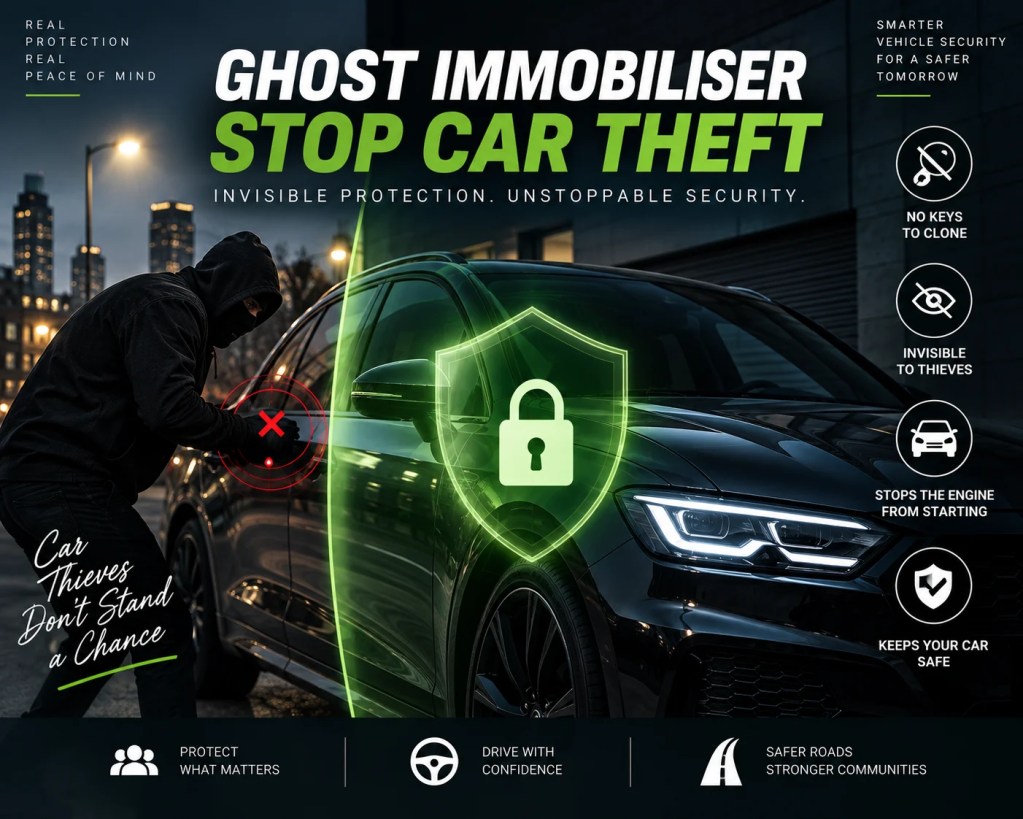
Ghost Immobiliser Stop Car Theft: 7 Powerful Security Facts for 2026
Car theft has become increasingly sophisticated, with criminals using a combination of physical and electronic techniques to target modern vehicles. Factory security systems remain an important first line of defence, but many drivers now consider additional aftermarket protection.
This raises an important question: how does a Ghost Immobiliser stop car theft?
A Ghost Immobiliser is designed to add another authentication barrier before a compatible vehicle can be driven. Rather than relying solely on the vehicle’s original key, the system can require a personalised PIN sequence entered through selected existing vehicle controls.
The Autowatch Ghost II, for example, is described by the manufacturer as a covert CAN-bus immobiliser that uses a personalised disarm sequence and does not require an additional RF key fob for its standard PIN-based operation.
In this guide, we’ll explain how a Ghost Immobiliser can help prevent vehicle theft, the technology behind it, its advantages for keyless cars and why layered security is important.
What Is a Ghost Immobiliser?
A Ghost Immobiliser is an aftermarket electronic vehicle security system designed to make unauthorised vehicle use more difficult.
Unlike a steering lock, it does not physically restrict the steering wheel. Instead, it can introduce an additional authentication requirement before the vehicle can be driven.
On the Ghost II, the driver enters a unique sequence through existing vehicle buttons. The manufacturer describes the system as a covert CAN-bus immobiliser designed to work with the vehicle’s electronic architecture. (autowatch.co.uk)
The system is therefore intended to work alongside the vehicle’s factory security rather than simply replacing it.
How Does a Ghost Immobiliser Stop Car Theft?
The simplest explanation is that it adds another barrier between access to the vehicle and being able to drive it.
A thief could potentially gain access to a vehicle through a stolen key, keyless attack or another method. However, with a compatible Ghost system active, an additional authentication sequence may still be required before authorised driving is possible.
This is why a Ghost Immobiliser can play an important role in car-theft prevention.
It doesn’t simply warn you that somebody is attempting to steal the car. It is designed to make unauthorised operation more difficult.
7 Ways a Ghost Immobiliser Can Help Stop Car Theft
1. Adds an Additional Authentication Barrier
The most important way a Ghost Immobiliser can help stop car theft is through additional driver authentication.
The vehicle’s original key may provide access to the factory security system, but a Ghost system can require a separate personalised sequence.
With the Ghost II, that sequence is entered through existing vehicle controls. (autowatch.co.uk)
This creates another step for an unauthorised person to overcome before the vehicle can be driven normally.
For a vehicle owner, the key benefit is that the security system is not dependent solely on possession of the original vehicle key.
2. Makes Stolen or Cloned Keys Less Useful
One concern with modern vehicle theft is that gaining access to a key or its electronic credentials can potentially give a criminal an advantage.
A Ghost Immobiliser adds another authentication layer.
Even if someone has obtained a legitimate key, the additional PIN requirement can still prevent normal authorised operation when the immobiliser is active.
Autowatch specifically markets Ghost II as protection against key cloning and relay theft. (autowatch.co.uk)
This does not mean stolen or cloned keys become completely useless in every possible situation. Instead, the additional immobilisation layer can make unauthorised vehicle use more difficult.
3. Provides Discreet Security
A major advantage is that a Ghost Immobiliser is designed to be concealed.
A steering lock is deliberately visible. A thief can see it through the vehicle window.
A Ghost Immobiliser takes the opposite approach.
Autowatch describes the Ghost II as a covert immobiliser with no visible LED and no additional RF key fob for its standard PIN-based operation. (autowatch.co.uk)
This means a person inspecting the vehicle may not immediately know that an additional security system has been installed.
Discreet security can therefore make it harder to identify the specific aftermarket protection in advance.
4. Adds Protection for Keyless Vehicles
Keyless vehicles provide convenience, but they also create additional security considerations.
Thatcham Research has highlighted vulnerabilities associated with passive keyless entry and recommends precautions such as keeping keys away from doors and windows and using appropriate signal-blocking protection where relevant.
A Ghost Immobiliser can provide another layer beyond the keyless-entry system.
This means that even if the keyless system is targeted, an additional authentication requirement can still exist before normal driving is permitted.
However, a Ghost Immobiliser should not be treated as a substitute for protecting the key itself.
5. Uses the Vehicle’s Existing Controls
The Ghost II’s standard authentication method uses existing vehicle buttons rather than requiring an additional RF immobiliser remote.
This can provide two benefits.
First, the driver does not necessarily have another security fob to carry.
Second, the absence of a separate remote can make the system less obvious.
For everyday drivers, using existing controls can also make additional security easier to incorporate into normal driving.
6. Uses CAN-Bus Integration
CAN Bus is an electronic communication network used by many modern vehicles.
The Ghost II is designed as a CAN-bus immobiliser, allowing it to communicate with the vehicle’s electronic systems.
This integration is part of how the system can create an additional authentication requirement without relying on a large visible security device.
Because vehicle electronic architectures differ, however, the exact operation and compatibility vary.
The manufacturer provides a compatibility checker for Ghost systems, making it important to verify the exact vehicle before installation. (autowatch.co.uk)
7. Creates a Layer Beyond Factory Security
Modern cars can already have several security features.
These may include:
- Factory immobilisation
- Central locking
- Vehicle alarm
- Key authentication
- Keyless entry
- Engine-management security
A Ghost Immobiliser adds another layer rather than requiring the owner to depend entirely on one system.
Thatcham Research recommends a layered approach to vehicle security that can include alarms, immobilisers, tracking systems and physical deterrents.
This makes a Ghost system particularly useful when considered as part of a wider security strategy.
Ghost Immobiliser vs Factory Immobiliser
A factory immobiliser is installed by the vehicle manufacturer and forms part of the original vehicle security architecture.
A Ghost Immobiliser is an aftermarket system installed later.
The important distinction is that the Ghost system can introduce an additional authentication stage.
| Feature | Factory Immobiliser | Ghost Immobiliser |
|---|---|---|
| Factory installed | Yes | No |
| Electronic security | Yes | Yes |
| Additional PIN authentication | Vehicle dependent | Available on compatible systems |
| Covert aftermarket layer | No | Yes |
| Uses existing vehicle controls | Vehicle dependent | Yes on Ghost II |
| Works alongside factory security | Built in | Designed as additional protection |
Therefore, the existence of a factory immobiliser does not necessarily make aftermarket immobilisation irrelevant.
Ghost Immobiliser vs Traditional Alarm
An alarm and immobiliser have different primary purposes.
An alarm is designed to detect and alert.
An immobiliser is designed to restrict unauthorised vehicle operation.
For example, an alarm can produce an audible warning when an intrusion is detected. A Ghost Immobiliser can add an authentication barrier before the vehicle can be driven.
This is why some drivers choose to use both.
Alarm
Detection and audible/visual deterrence.
Ghost Immobiliser
Additional starting and authentication protection.
Together, the two technologies can provide broader security.
Ghost Immobiliser vs Steering Lock
A steering lock is a physical and highly visible security device.
A Ghost Immobiliser is an electronic and discreet security system.
The steering lock can deter a thief before they attempt to drive the vehicle, while the immobiliser can create another barrier against unauthorised vehicle operation.
For this reason, using both can create complementary layers.
Ghost Immobiliser vs Tracker
A tracker performs a different role again.
An immobiliser focuses on prevention.
A tracker focuses on tracking and recovery.
For example:
Ghost Immobiliser → Helps prevent unauthorised use
Tracker → Helps locate the vehicle after theft
For high-value vehicles, combining the technologies may provide broader protection.
Thatcham Research classifies S5 as Vehicle Tracking Systems and S7 as Asset Location Systems. (thatcham.org)
Does a Ghost Immobiliser Completely Stop Car Theft?
No security system should be described as completely theft-proof.
A Ghost Immobiliser is designed to make unauthorised vehicle use more difficult by adding another authentication requirement.
However, vehicle theft involves different risks and attack methods.
For this reason, the strongest security strategy is usually layered.
A vehicle owner may combine:
Ghost Immobiliser: Additional starting protection.
Tracker: Location and recovery.
Steering Lock: Visible physical deterrence.
Key Protection: Reduces risks associated with keyless systems.
Secure Parking: Reduces exposure to opportunistic theft.
Using multiple appropriate measures can reduce reliance on a single security product.
Can a Ghost Immobiliser Protect a Keyless Car?
A compatible Ghost Immobiliser can provide an additional security layer for keyless vehicles.
Thatcham Research recommends that keyless owners consider practical measures such as storing keys away from doors and windows and using suitable signal-blocking protection where appropriate. (thatcham.org)
The best approach is therefore:
Protect the key + protect the vehicle.
An immobiliser addresses vehicle operation, while secure key practices address the keyless-entry side of the risk.
Does Ghost Immobiliser Need a Separate Key Fob?
The Autowatch Ghost II’s standard PIN-based operation does not require an additional RF key fob. Instead, the driver uses the vehicle’s existing controls to enter the personalised disarm sequence. (autowatch.co.uk)
Some eligible Ghost products can also support optional tags or phone-based functionality.
The exact available features depend on the specific Ghost model and vehicle.
Is a Ghost Immobiliser Thatcham Approved?
This needs to be checked carefully.
Thatcham Research operates certification schemes for automotive security products, including electronic immobilisers and alarms.
However, certification applies to specific products and categories.
You should therefore verify the current certification status of the exact product being installed rather than assuming every Ghost product has identical certification.
Thatcham also states that certification does not automatically guarantee insurer recognition.
If you’re installing the immobiliser because of an insurance requirement, contact your insurer before purchase.
Does a Ghost Immobiliser Affect Car Insurance?
Insurance recognition depends on the individual provider and policy.
Some insurers may have specific requirements for additional security on certain vehicles.
Others may not offer a discount simply because an aftermarket immobiliser has been installed.
Before purchasing, ask your insurer:
- Is an aftermarket immobiliser required?
- Does the product need certification?
- Does the installer need to be approved?
- Is an installation certificate required?
- Will the device affect my premium?
Getting confirmation in advance is the safest approach.
Ghost Immobiliser Installation
Professional installation is an important part of vehicle security.
The Ghost system interacts with the vehicle’s electronic architecture, so the installer should be familiar with the specific make and model.
Before installation, confirm:
Compatibility
Make sure your exact vehicle is supported.
Installer Experience
Choose a qualified or appropriately trained installer.
Product Authenticity
Confirm the exact Ghost model being fitted.
Warranty
Ask about product and installation warranty.
Handover
The installer should explain your PIN, normal operation and Service/Valet Mode where applicable.
How Much Does a Ghost Immobiliser Cost?
The price varies by vehicle, Ghost system, installer and installation requirements.
Current UK installation advertisements commonly place Ghost II fitting in the region of £499, but this is not a universal price and can vary between providers and vehicles.
When comparing quotes, check whether the price includes:
- Hardware
- Professional installation
- VAT
- PIN configuration
- Warranty
- Aftercare
The cheapest quote is not automatically the best choice for an electronic security system.
How to Make Your Car Even Harder to Steal
A Ghost Immobiliser Stop Car Theft strategy should include more than one measure.
Consider:
- Keeping keys away from external doors and windows.
- Using suitable signal-blocking storage for vulnerable keyless systems.
- Using a visible steering lock.
- Considering an S5 or appropriate tracking system.
- Parking in secure locations.
- Keeping vehicle software updated.
- Following manufacturer security recommendations.
Thatcham Research recommends considering multiple appropriate vehicle-security measures rather than relying on a single product.
Final Verdict: Can a Ghost Immobiliser Stop Car Theft?
So, can a Ghost Immobiliser stop car theft?
It can help prevent unauthorised vehicle use by adding an additional authentication barrier beyond the vehicle’s standard key and factory security.
The strongest advantages include:
- Personalised driver authentication
- Covert installation
- Additional starting protection
- Protection against certain key-related theft techniques
- CAN-bus integration
- No separate RF fob for standard Ghost II PIN operation
- Compatibility with layered security strategies
However, no device can guarantee that a vehicle will never be stolen.
For drivers with high-value or higher-risk vehicles, the most sensible strategy is to combine appropriate security layers. A Ghost Immobiliser can provide preventative protection, while a suitable tracker can provide location and recovery support, and physical security can add visible deterrence.
The right setup depends on your vehicle, risk level, parking arrangements and insurance requirements.
Frequently Asked Questions
How does a Ghost Immobiliser stop car theft?
A Ghost Immobiliser can help prevent unauthorised vehicle use by requiring an additional authentication sequence before the vehicle can be driven. The Ghost II uses a personalised sequence through existing vehicle controls.
Can a Ghost Immobiliser stop car theft completely?
No. It is designed to make unauthorised vehicle use more difficult, but no vehicle-security system can guarantee complete protection against every theft method.
Can a Ghost Immobiliser Stop Car Theft protect against key cloning?
The manufacturer markets the Ghost II as protection against key cloning and relay theft. The additional authentication layer means possession of the original vehicle key alone may not be sufficient for normal authorised use.
Does a Ghost Immobiliser Stop Car Theft work on keyless cars?
A compatible system can provide an additional security layer for keyless vehicles. Owners should still protect their keys and follow appropriate keyless-security recommendations.
Does Ghost Immobiliser require a separate key fob?
The standard Ghost II PIN-based system uses the vehicle’s existing controls rather than requiring a separate RF immobiliser key fob.
Is a Ghost Immobiliser better than a factory immobiliser?
They serve different roles. A factory immobiliser provides the vehicle’s original security, while a Ghost Immobiliser can add another aftermarket authentication layer.
Is a Ghost Immobiliser better than a steering lock?
They provide different types of protection. A steering lock is a visible physical deterrent, while a Ghost Immobiliser provides discreet electronic protection. Using both can provide complementary layers.
Should I use a Ghost Immobiliser with a tracker?
They perform different functions. A Ghost Immobiliser focuses on prevention, while a tracker focuses on vehicle location and recovery. Using both can provide broader protection.
Is a Ghost Immobiliser Stop Car Theft Thatcham approved?
Check the current certification status of the exact Ghost product. Thatcham certification applies to specific products, and certification does not automatically guarantee insurer recognition.
How much does a Ghost Immobiliser Stop Car Theft cost?
Prices vary by vehicle and installer. UK advertised Ghost II installations are commonly around £499, but you should obtain a vehicle-specific quote and confirm exactly what is included.
Does a Ghost Immobiliser Stop Car Theft affect my insurance?
It can be relevant to some insurance policies, but recognition varies between insurers. Confirm the exact requirements with your insurer before installation.
Is a Ghost Immobiliser Stop Car Theft worth it for a high-value car?
It can be worth considering as an additional electronic security layer, particularly for high-value or higher-risk vehicles. A layered setup combining prevention, physical deterrence and tracking can provide broader protection.
Follow us on instagram.