
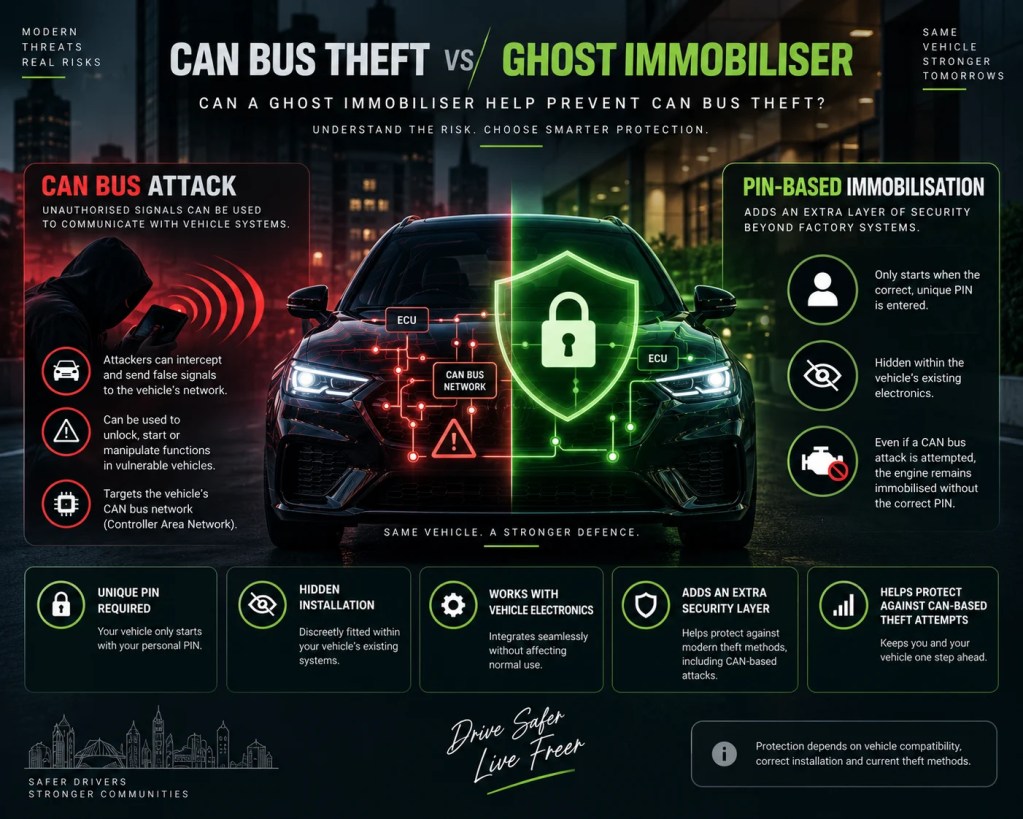
Can a Ghost Immobiliser Prevent CAN Bus Theft? 7 Powerful Facts UK Drivers Should Know
Modern vehicles rely heavily on electronic systems, which can unfortunately create new opportunities for sophisticated vehicle theft. One method that has attracted increasing attention is Ghost Immobiliser prevent CAN Bus theft, where criminals attempt to manipulate a vehicle’s internal communication network to gain unauthorised control.
This raises an important question for vehicle owners: Can a Ghost Immobiliser prevent CAN Bus theft?
A Ghost Immobiliser is designed specifically as a covert electronic immobilisation system that integrates with a vehicle’s CAN Bus network. Rather than relying on a traditional visible alarm or additional key fob, the system requires an authorised PIN sequence through the vehicle’s existing controls before the vehicle can be driven.
Let’s examine how CAN Bus theft works, what a Ghost Immobiliser does, and why it can provide an additional security layer for modern vehicles.
What Is CAN Bus Theft?
CAN stands for Controller Area Network. It is the communication system that allows different electronic control units within a vehicle to exchange information.
Modern cars may use CAN Bus communication for functions such as:
- Engine and transmission communication
- Central locking
- Dashboard functions
- Security systems
- Vehicle control modules
A CAN Bus attack attempts to exploit access to this electronic network. Instead of simply stealing or duplicating a physical key, criminals may try to gain access to the vehicle’s electronic systems and send messages that make the vehicle behave as though an authorised command has been received.
This is one reason conventional security measures alone may not provide enough protection against every modern theft technique.
Can a Ghost Immobiliser Prevent CAN Bus Theft?
The answer is it can provide an important additional barrier against unauthorised driving following certain electronic attacks, but no aftermarket security system should be described as guaranteeing protection against every possible theft method.
The Autowatch Ghost-II is a covert CAN-bus immobiliser. It uses the vehicle’s existing controls to accept a personalised disarm sequence. Until the correct authorisation is entered, the immobilisation function prevents the vehicle from being driven normally.
This is particularly useful because the system doesn’t depend on an additional wireless remote control for its normal PIN operation.
In practical terms, even if criminals attempt to manipulate the vehicle’s electronic systems, they still face the immobiliser’s authorisation requirement.
7 Powerful Ways a Ghost Immobiliser Helps Against CAN Bus Theft
1. It Adds a Separate Authorisation Requirement
A factory key may successfully unlock or authenticate a vehicle, but an additional immobiliser can introduce another layer of authorisation.
With Ghost-II, the driver enters a personalised sequence using existing vehicle buttons. The vehicle then verifies the sequence before allowing normal driving.
This creates a security layer beyond the original factory authentication process.
2. It Uses the Vehicle’s Existing Controls
One of the major features of a Ghost Immobiliser is that there is no additional key fob required for the standard disarm process.
Instead, the driver can use suitable existing steering-wheel, dashboard or other vehicle controls to enter the personalised sequence.
That means owners don’t have another remote device that could become a target.
3. It Has No Conventional RF Signal to Intercept
Relay theft often focuses on wireless communication between a vehicle and its key.
Ghost-II does not use an additional RF key fob for its normal PIN disarm operation. Autowatch specifically highlights the absence of extra key fobs and radio signals as part of the system’s design.
This makes a Ghost system complementary to other measures aimed at protecting keyless entry systems.
4. It Is Installed Covertly
Visible security hardware can reveal what protection a vehicle has.
The Ghost system is designed to integrate discreetly with the vehicle’s CAN network rather than relying on an obvious visible control unit. Autowatch describes the system as covert and integrated into the vehicle’s internal network.
A thief may therefore have difficulty identifying the aftermarket immobiliser simply by looking inside the cabin.
5. It Can Make Electronic Theft Techniques Less Effective
CAN Bus and other electronic theft methods can focus on obtaining or manipulating vehicle authorisation.
A Ghost Immobiliser adds another condition: the correct personalised disarm sequence must be recognised before the vehicle can be driven.
Autowatch markets Ghost as protection against modern theft methods including key cloning and relay attacks.
The important point is that the immobiliser is intended to make unauthorised driving more difficult, rather than simply sounding an alarm after an intrusion.
6. It Does Not Depend on a Traditional Visible Alarm
An alarm is primarily designed to provide a warning when a security event occurs.
An immobiliser has a different purpose. It is intended to prevent or restrict unauthorised vehicle use.
Ghost-II combines covert integration with an authorisation sequence, meaning its main role is to create an additional barrier to driving the vehicle without authorisation.
7. It Can Work as Part of a Layered Security Strategy
No single security device needs to do everything.
A Ghost Immobiliser is designed primarily to prevent unauthorised use, while a tracker is intended to help locate or recover a vehicle after theft.
For higher-value vehicles, combining an immobiliser with an appropriate tracking system, physical security and good key-management practices can create a more comprehensive security strategy.
Ghost Immobiliser vs Factory Security
Modern cars already come with sophisticated factory security. So why add another immobiliser?
The answer is that the two systems serve different roles.
| Feature | Factory Security | Ghost Immobiliser |
|---|---|---|
| Factory installed | Yes | No |
| Immobilisation | Usually included | Additional immobilisation layer |
| Extra PIN authorisation | Usually no | Yes |
| Uses vehicle controls | Depends on manufacturer | Yes |
| Additional RF key fob | Manufacturer dependent | Not required for normal PIN operation |
| Covert aftermarket installation | No | Yes |
| Designed to add protection against modern theft methods | Manufacturer dependent | Yes |
The exact protection offered by factory security varies significantly between vehicle makes, models and years. Therefore, compatibility and the vehicle’s existing security architecture should always be assessed before installation.
Can CAN Bus Attacks Still Be Possible With a Ghost Immobiliser?
It is important to avoid the claim that any immobiliser makes a vehicle completely theft-proof.
Cyber-physical vehicle attacks continue to evolve, and vehicle security depends on the specific make, model, software architecture, installation quality and attack method.
A Ghost Immobiliser is best understood as an additional security barrier rather than an absolute guarantee.
Its advantage is that a thief may gain some level of electronic access to a vehicle but still face the separate immobilisation requirement before being able to drive away.
Ghost Immobiliser and Keyless Theft
CAN Bus attacks and relay theft are not exactly the same thing.
Relay theft generally involves extending or manipulating communication between a keyless vehicle and its key. CAN Bus theft, by contrast, can involve interaction with the vehicle’s internal electronic communication systems.
Ghost can complement keyless-security measures because its standard disarm process does not depend on the vehicle’s keyless RF signal.
For additional protection, owners should also consider where they keep their keys and whether keyless-entry functionality can be adjusted on their vehicle.
Is a Ghost Immobiliser Suitable for Every Car?
Not necessarily.
Compatibility depends on the vehicle’s make, model, year and electronic architecture. Autowatch maintains a compatibility database covering a wide range of vehicles and currently lists compatibility for both Ghost-II and Ghost-III across numerous makes and models.
Before installation, owners should check their exact vehicle rather than assuming that a system compatible with one model will work with another.
Professional installation is also important because the immobiliser interfaces with the vehicle’s electronic systems.
Does a Ghost Immobiliser Replace a Tracker?
No.
A Ghost Immobiliser and a tracker perform different functions.
A Ghost Immobiliser is primarily intended to help prevent unauthorised driving. A tracker is designed to help locate a vehicle and support recovery if it is stolen.
For vehicles at greater theft risk, using both can provide complementary protection.
A useful approach is:
Prevent → Detect → Recover
A Ghost Immobiliser supports the prevention stage, while an appropriate tracking system can provide support if the vehicle is stolen.
Is Ghost Immobiliser Thatcham Approved?
Care should be taken with certification terminology.
Thatcham Research operates a security certification programme covering specific categories of aftermarket vehicle security products, including electronic immobilisers and vehicle tracking systems. Certification verifies performance against defined criteria. However, Thatcham also states that certification does not automatically guarantee insurer recognition, because insurer recognition is negotiated separately between manufacturers and insurers.
For insurance purposes, vehicle owners should therefore confirm the requirements directly with their insurer and check the precise product and certificate details.
Benefits of Adding Ghost Immobiliser Security
For UK drivers concerned about modern vehicle theft, a professionally installed Ghost Immobiliser can offer several potential advantages:
Extra protection: It adds another immobilisation layer to factory security.
Discreet design: There is no obvious dashboard immobiliser control or standard visible LED installation.
PIN-based authorisation: The driver uses a personalised sequence through existing vehicle controls.
No additional key fob: Normal operation does not require carrying another remote.
Modern security approach: It is designed around contemporary electronically controlled vehicles and CAN Bus integration.
How to Protect Your Car From CAN Bus Theft
A layered approach is generally more sensible than depending on one device.
Consider the following:
Keep vehicle keys away from doors and windows.
Use a tested Faraday pouch where appropriate for keyless systems.
Consider a visible steering-wheel lock as an additional physical deterrent.
Install a professionally fitted immobiliser appropriate for the vehicle.
Consider a suitable tracker for recovery support.
Keep vehicle software and security updates current where the manufacturer provides them.
Park in secure, well-lit locations whenever possible.
Review your insurance requirements before choosing aftermarket equipment.
Final Verdict: Can a Ghost Immobiliser Prevent CAN Bus Theft?
So, can a Ghost Immobiliser prevent CAN Bus theft?
A Ghost Immobiliser can provide a strong additional barrier against unauthorised vehicle use following modern electronic attacks because it requires a personalised disarm sequence before the vehicle can be driven. The Ghost-II is specifically designed as a covert Ghost Immobiliser Prevent CAN Bus Theft and does not require an additional RF key fob for its standard PIN operation.
However, it should not be described as an absolute guarantee against every Ghost Immobiliser Prevent CAN Bus Theft attack or every form of vehicle theft.
For the best overall protection, consider a layered strategy combining an appropriate immobiliser, physical security, keyless-security precautions and, where suitable, a quality tracking system.
FAQs
Does a Ghost Immobiliser protect against CAN Bus attacks? (Ghost Immobiliser Prevent CAN Bus Theft)
It can add an additional authorisation barrier against unauthorised driving, including after attempts to manipulate vehicle electronics. It should not be presented as a guarantee against every possible CAN Bus attack.
Can thieves bypass a Ghost Immobiliser? (Ghost Immobiliser Prevent CAN Bus Theft)
No security system should be considered impossible to bypass. The effectiveness of a Ghost Immobiliser depends on the vehicle, installation, system configuration and the attack being attempted.
Does Ghost Immobiliser use CAN Bus? (Ghost Immobiliser Prevent CAN Bus Theft)
Yes. Ghost-II is a covert CAN-bus immobiliser designed to integrate with the vehicle’s electronic network.
Does Ghost Immobiliser prevent relay theft? (Ghost Immobiliser Prevent CAN Bus Theft)
Autowatch states that Ghost-II is designed to help prevent relay theft because its normal PIN disarm process does not rely on an additional RF key fob.
Is a Ghost Immobiliser better than a factory immobiliser? (Ghost Immobiliser Prevent CAN Bus Theft)
It is not simply a matter of one being better. A Ghost Immobiliser is an additional aftermarket security layer designed to complement the vehicle’s existing factory security.
Should I combine a Ghost Immobiliser Prevent CAN Bus Theft with a tracker? (Ghost Immobiliser Prevent CAN Bus Theft)
For higher-value or higher-risk vehicles, combining an immobiliser with a suitable tracker can provide complementary prevention and recovery protection.
How do I know whether Ghost Immobiliser Prevent CAN Bus Theft is compatible with my car? (Ghost Immobiliser Prevent CAN Bus Theft)
Check the exact make, model and year against the manufacturer’s compatibility information before arranging installation. Autowatch provides an online compatibility database.
Follow us on instagram.